
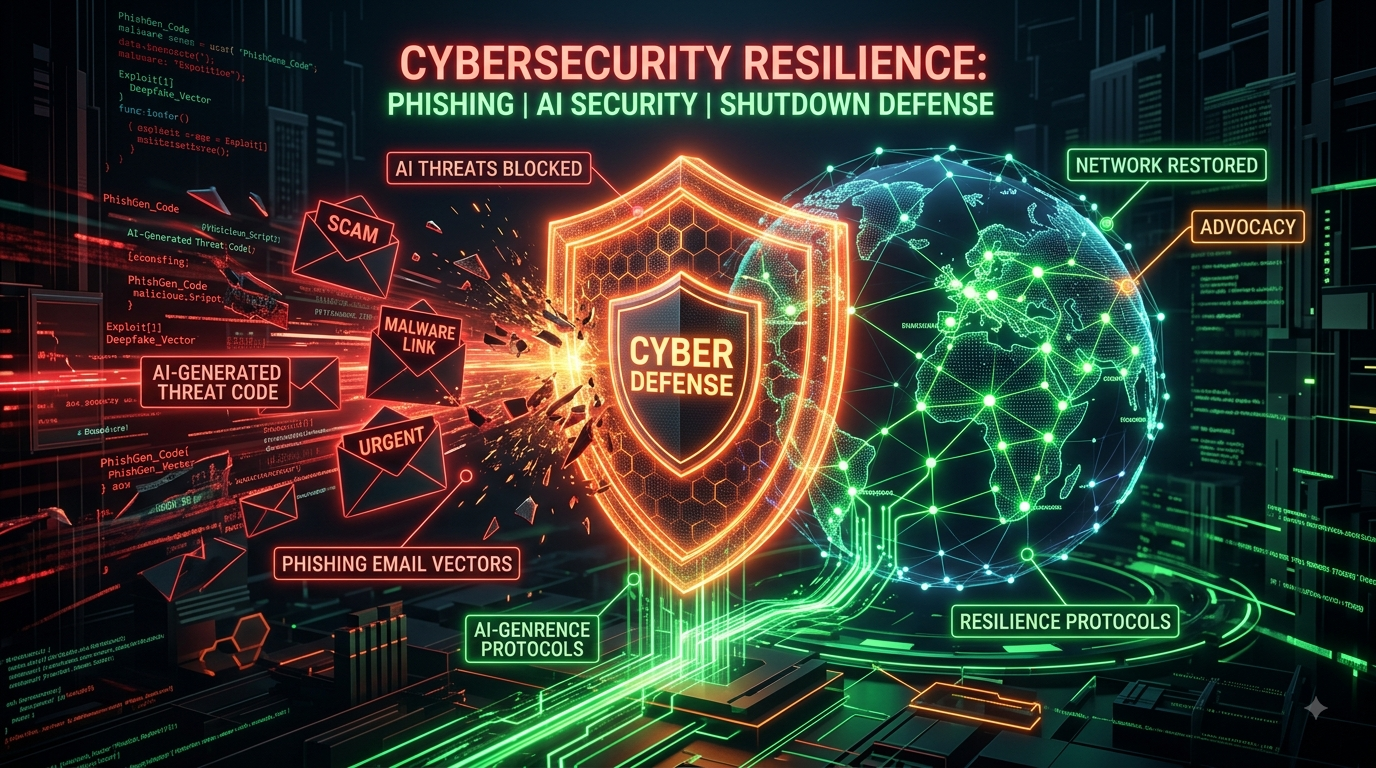
Beyond volumetric attacks and web application intrusions, the security of civil society organizations is constantly challenged at the communication layer and in the availability of network infrastructure itself.
The final part of the 2026 Report on Cyberattacks Against Civil Society, published by Cloudflare, sheds light on two high-impact interference vectors: sophisticated malicious email campaigns and state-sponsored connectivity disruption.
With almost 10% of all emails processed for civic entities containing deceptive links or scams, the report points to a scenario where social engineering and infrastructure censorship go hand in hand.
Below, we analyze the evolution of these threats and the platform's technical recommendations.
- ADVANCED PHISHING, IMPERSONATED BRANDS, AND AUTHENTICATION BYPASS
Email remains the main entry point for social engineering vectors, but the technical complexity of attacks has significantly increased:
Bypassing Standard Filters: Cloudflare Email Security identified 1.2 million highly malicious emails targeting project participants. Of these, 30.2% managed to bypass standard authentication checks (such as sender signatures and content integrity), being intercepted only by mechanisms based on behavioral analysis and AI.
Impersonation Tactics: The main techniques involved deceptive links (19.5%), impersonation of known authorities (16.8%), and unauthorized use of trusted brands (13.4%). The most impersonated brands were Apple, DocuSign, Datadog, American Express, and Intuit.
Newly Registered Domains: Almost half of the threats used newly created domains to bypass historical reputation lists.
The Impact of Generative AI: Language models have expanded the ability to create hyper-personalized messages at scale. A highlighted example was an investigation that mapped email campaigns suspected of using AI to compromise Microsoft cloud accounts in over 340 civic entities.
- GOVERNMENT-DIRECTED INTERNET BLACKOUTS (INTERNET SHUTDOWNS)
When cyber infrastructure resists, physical connectivity itself becomes the target. The report cataloged 183 internet disruptions worldwide, of which 85 were directed by governments during protests, elections, and student exams:
Uganda (January 2026 Elections): The local communications commission ordered the blocking of mobile access and services before the election. Traffic dropped 95% in just 30 minutes, generating an estimated economic loss of US$ 16 million and hindering independent electoral oversight.
Iran (January 2026): Cloudflare identified eight state-sponsored blockages in the country during the analyzed period. On January 8, traffic dropped 90% in 30 minutes and reached zero in two hours, isolating the country from the global internet and preventing the recording of human rights violations.
- OFFICIAL RECOMMENDATIONS FOR CIVIC DEFENSE
To mitigate the advancement of these combined threats, the report establishes three fundamental pillars:
Universal Access to Cybersecurity Services: Simplification and cost reduction of defensive tools to ensure that all organizations operate under a secure baseline.
Transparency and Telemetry Sharing: Public and integrated monitoring among stakeholders regarding blackouts and attacks to inform protection and accountability policies.
Accessibility to AI-Powered Defense Tools: Ensuring that protections against malicious artificial intelligence and post-quantum cryptography are integrated by default into tools used by NGOs and the press.
CONCLUSION: STRENGTHENING THE DIGITAL ECOSYSTEM
The three parts of the Cloudflare 2026 Report reinforce that ensuring the security of civil society is not an isolated IT issue, but a requirement for the preservation of democracies and fundamental rights in the digital age.
Building a resilient online environment requires the continuous effort of infrastructure providers, developers, and regulatory bodies in democratizing state-of-the-art defenses.
Official sources and references:
- Official Report "2026 Cloudflare Report on Cyberattacks Against Civil Society" — Project Galileo & Cloudflare Research.
- Phishing Telemetry, Email Incidents, and Global Connectivity Outages — Cloudflare Radar & Email Security.
- Impact Analyses and Case Studies (Citizen Lab, Huntress, CIPESA, Internet Society Pulse).
This article was supported by artificial intelligence through Gemini (Google) in the development of its editorial structure.