
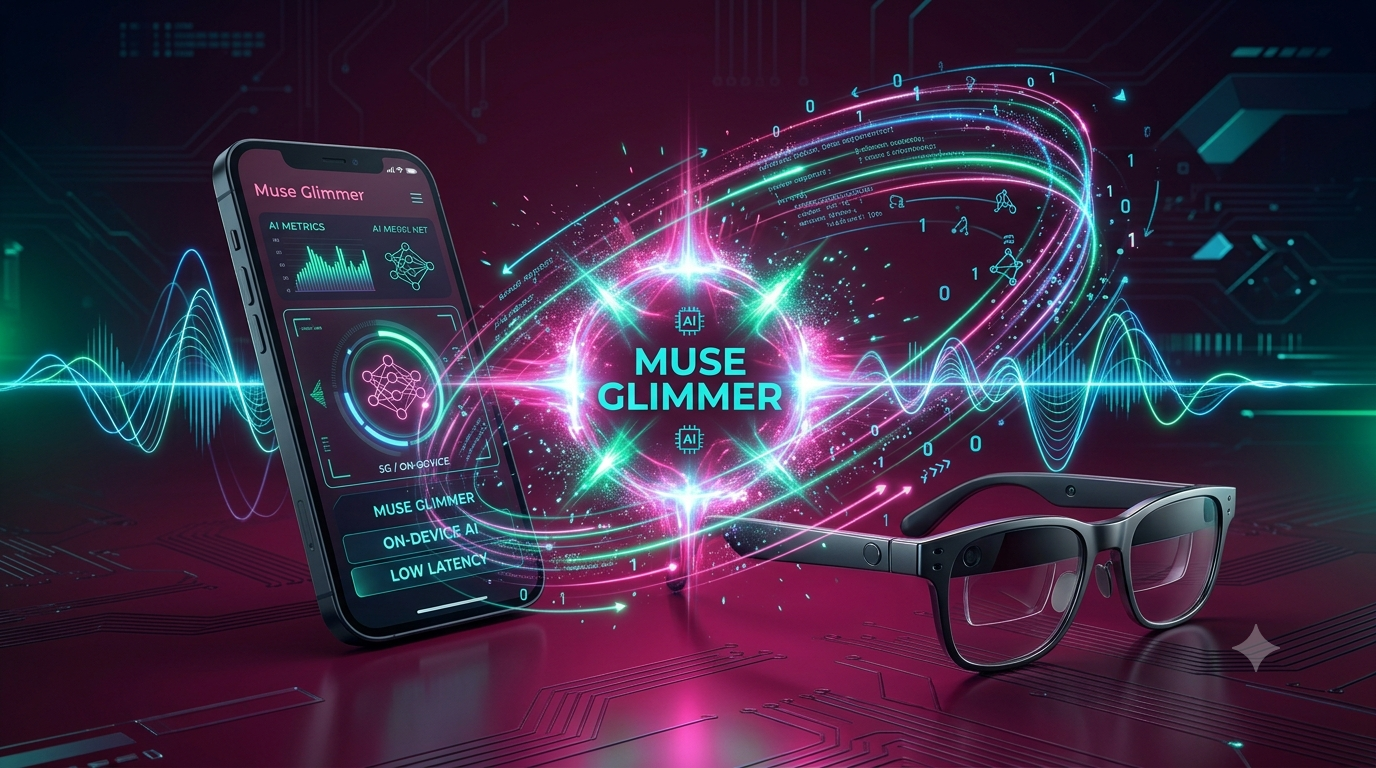
While the race to train super-giant AI models demands high-energy-consumption datacenters and clusters, there is a growing and strategic demand for efficient intelligence operating at the edge (Edge AI).
To address this high-density ecosystem with restricted computational resources, Meta has introduced Muse Glimmer, an addition to its family of open models focused on efficiency, ultra-low latency, and local execution (on-device).
The model was designed to run on smartphones, smart glasses, and Internet of Things (IoT) devices without the need to send constant requests to remote servers.
Below, we analyze Muse Glimmer's architectural innovations and practical impact on the future of mobile applications and devices.
- OPTIMIZED ARCHITECTURE FOR LOCAL EXECUTION (ON-DEVICE)
Muse Glimmer's major technical differentiator lies in its compression rate and memory (RAM) efficiency, allowing for millisecond inference times:
Quantization and Knowledge Distillation: The model was trained using advanced distillation techniques to condense the reasoning of larger architectures into a reduced size, while maintaining high accuracy in text comprehension, summarization, and basic logic tasks.
Reduced Energy Consumption: Local processing avoids continuous radio and data transmissions (4G/5G/Wi-Fi), extending battery life in portable and wearable devices.
Data Privacy by Design: By processing requests directly on the user's hardware, sensitive data, conversation history, and personal information do not need to travel over the internet, meeting strict compliance and privacy requirements.
- PRACTICAL APPLICATIONS AND USE CASES
The ability to deliver instant responses without stable connection dependency opens new possibilities for developers:
Wearables and Smart Glasses: Real-time processing of voice commands, simultaneous translation, and navigation without the delay (lag) caused by cloud API calls.
Offline Messaging Assistants: Ability to draft, suggest responses, and organize tasks within Meta's application ecosystem (WhatsApp, Instagram, Messenger) even in locations without internet signal.
Home Automation and IoT: Instant control of smart home devices with local processing, ensuring that doors, lights, and alarms respond even during network connection interruptions.
- THE HYBRID TREND OF CORPORATE AND PERSONAL AI
The launch of Muse Glimmer consolidates the transition to a Hybrid AI model. In this model, everyday tasks, data triage, and immediate responses are executed locally on the device itself by the lightweight model.
Only when the request requires deep reasoning, analysis of large volumes of text, or complex code generation does the device redirect the task to larger models hosted in the cloud.
This approach drastically reduces infrastructure operational costs for developers and ensures a fluid and uninterrupted experience for the end-user.
CONCLUSION: ONSITE AND OMNIPRESENT ARTIFICIAL INTELLIGENCE
Muse Glimmer demonstrates that the future of artificial intelligence does not depend solely on increasing the raw capacity of servers, but also on the ability to make AI invisible, fast, and accessible everywhere.
By bringing processing power directly to the user's pocket, Meta strengthens the open models ecosystem and accelerates AI integration into daily interactions.
Official sources and references:
- Technical Documentation and Launch "Meta Muse Glimmer Model Overview" — Meta AI Developers (developer.meta.com/ai/models/muse-glimmer).
- On-Device Efficiency and Inference Benchmarks — Meta AI Research.
- Hybrid AI Architecture and Edge Computing — IEEE Computer Society.
This article was supported by artificial intelligence through Gemini (Google) in the development of its editorial structure.