
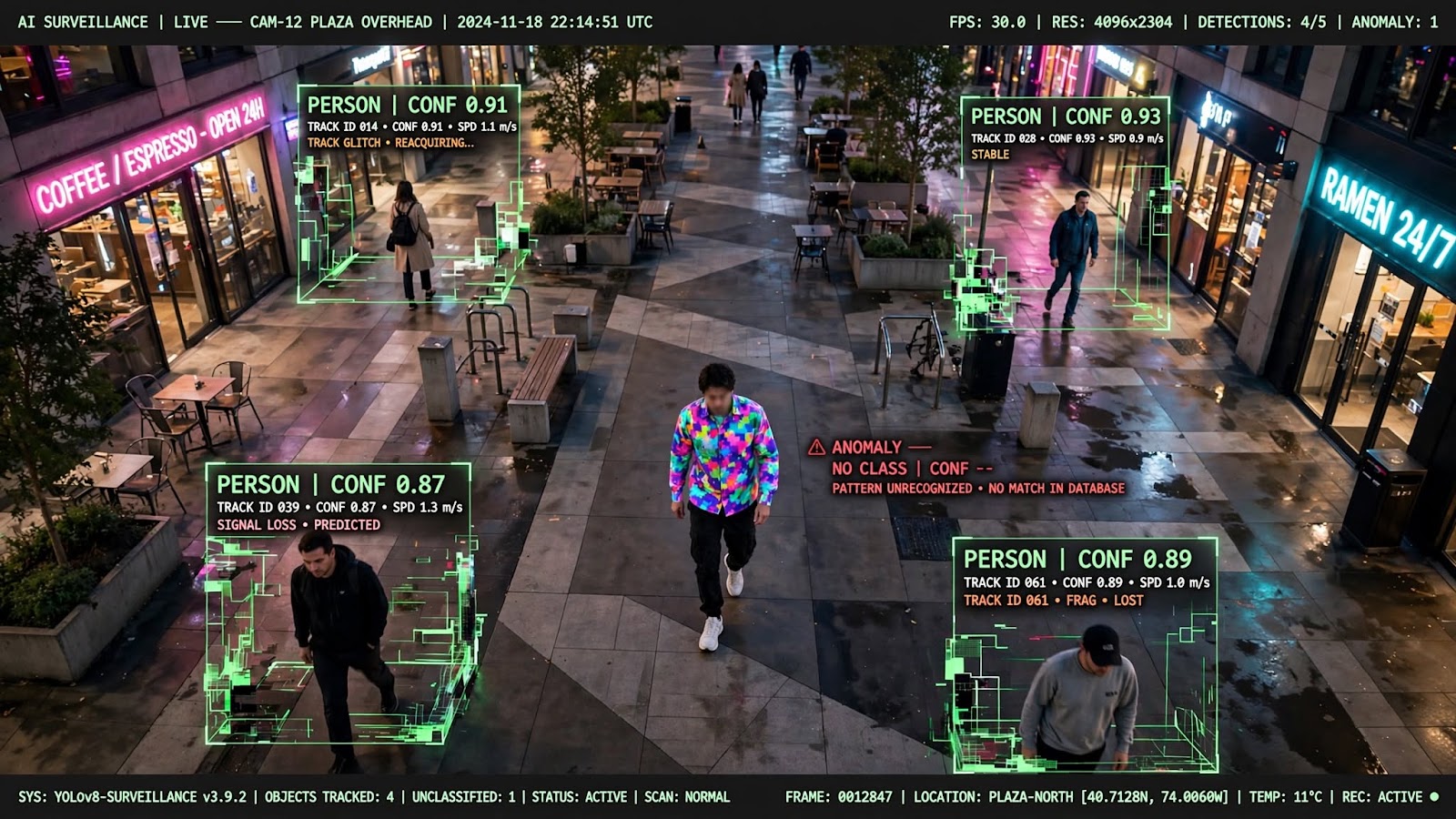
The proliferation of automated surveillance systems in major cities has found a direct algorithmic response in designer Simon Weckert's Digital Camouflage project. Developed as an immediate reaction to the deployment of AI video recognition pilots in public spaces, the garment challenges the premise that computer vision is infallible. This article examines the technical mechanisms of algorithmic failure, the process of creation via adversarial loops, and the impact of these interventions on public space governance.
The proliferation of automated surveillance systems in major cities found a direct algorithmic response in designer Simon Weckert's Digital Camouflage project. Developed as an immediate reaction to the deployment of AI video recognition pilots in Berlin's public squares, the garment challenges the premise that computer vision is infallible. Rather than concealing the face with traditional accessories, the shirt employs an AI-generated textile pattern designed to disrupt the object detection pipeline in real-time neural networks.
Part 1: The Anatomy of Algorithmic Failure
Modern computer vision models — such as the YOLO architecture used in field tests — do not perceive humans with the intuitive cognition of biology, but interpret shapes through cumulative statistical layers:
- Initial Layers: The algorithm tracks contrast gradients, edges, and fine textures in the captured image.
- Deep Layers: It searches for standardized body proportions, such as shoulder silhouettes and limb alignment with the torso.
- The Textile Pattern: Highly saturated color transitions generate extreme noise in the network's initial filters, while overlapping geometry fragments the body silhouette continuity required by deep layers.
To the human eye, the shirt displays an abstract, eye-catching pattern; to surveillance software, the wearer's body simply ceases to exist statistically as a valid human vector.
Part 2: The Adversarial Process and Public Space Governance
The most disruptive aspect of the initiative lies in the constructive method of the pattern:
- Iterative Adversarial Loop: The pattern was not drawn by human intuition, but generated jointly with the detection system itself. The designer submitted successive graphic variations to the AI, measuring the percentage drop in model confidence until the recognition score collapsed.
- Structural Vulnerability: This technique exposes the fragility of public safety policies based on blind automation. When governments outsource urban control to proprietary algorithms without resilience audits, they create rigid ecosystems that can be neutralized by low-cost, open-source countermeasures.
- Digital Sovereignty: The digital sovereignty of cities will not be guaranteed by the indiscriminate addition of surveillance cameras, but by a rigorous understanding of technical blind spots that render these technologies ineffective and easy to bypass.
Conclusion
Simon Weckert's project transcends the aesthetics of urban protest; it acts as a practical and visual audit of the limits of artificial intelligence applied to social control. As cities worldwide expand automated monitoring networks, digital camouflage demonstrates that the asymmetry between state surveillance and civil resistance will continue to be redefined by those who master the reverse engineering of predictive models.
Sources and References:
- Design and Tech Coverage — Dezeen: Digital camouflage shirt designed to trick AI video surveillance by Simon Weckert.
- Academic Research in Adversarial Attacks and Computer Vision.