
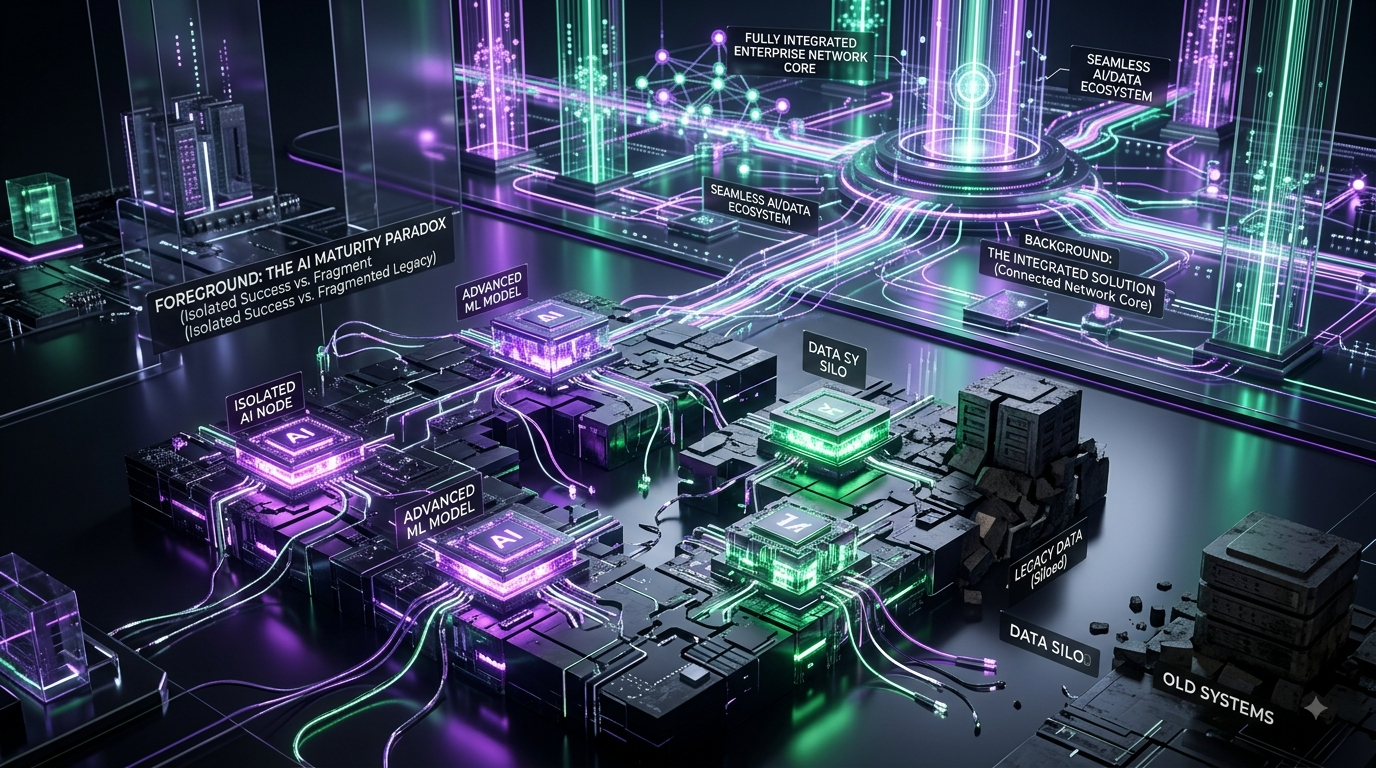
Generative Artificial Intelligence has solidified its place at the top of global executive agendas, driven by estimates such as McKinsey's, which points to a potential addition of up to US$ 4.4 trillion annually to the global economy. However, the phase of mere experimentation has given way to an operational paradox.
As language models become accessible, superficial automation commoditizes capabilities among competitors. The efficiency gained by generic assistants levels the playing field, but does not generate sustainable differentiation or new revenue streams.
As highlighted by the study published by MIT Sloan Management Review Brasil in partnership with Sensedia and Squadra Digital, the competitive differentiator is no longer in the algorithm itself and has shifted to the ability to connect AI to the business core, data, and decision-making processes.
Below, we analyze the causes of the "PoC purgatory" and the mismatch between leadership expectations and technical maturity.
1. THE POC PURGATORY AND INTEGRATION FAILURE
The MIT "State of AI in Business" report reveals an alarming statistic: 95% of AI projects fail not due to technology deficiencies, but due to a lack of strategy, poor data quality, and insufficient integration with company systems. Additionally, Deloitte research indicates that 60% of global leaders point to legacy systems as the biggest impediment to innovation.
This difficulty stems from the confusion between two distinct fronts of AI adoption:
- Internal Efficiency Gain: Specific cost reduction through generic generative assistants. Delivers limited value by operating in peripheral and isolated processes without altering business dynamics.
- Creation of Intelligent Products and Services: Development of specialized capabilities integrated into the operational workflow, creating competitive barriers and real scalability.
2. THE REALITY OF CORPORATE MATURITY
Research conducted during APIX with 277 executives and technology professionals exposes a structural mismatch between strategic intent and available infrastructure:
- Expectation vs. Execution: While 66.2% of executives state that AI is a defined priority or a central part of the business, only 7.4% of IT professionals report that AI is effectively integrated into multiple systems and processes.
- Stagnation in Pilots: More than half of organizations (51.6%) remain stuck in proofs of concept (PoCs) or isolated initiatives, while only 12.9% have scaled use cases in production.
- Data Access Bottleneck: In 54.4% of companies, AI has unstructured access to corporate data — with 31.6% relying on manual context insertion in prompts and 22.8% using AI without any access to internal data.
3. FROM SOFTWARE DESIGN TO DECISION ARCHITECTURE
The commoditization of code writing by generative tools shifts the value from traditional software engineering to decision architecture.
To overcome shallow automation, organizations need to adopt integral design methodologies, dividing business problems into four structural layers: mapping the Environment (internal/external factors), defining Services (what the system does), modeling Processes (execution dynamics), and Architecture infrastructure.
CONCLUSION: BUILDING THE FOUNDATION FOR SCALE
The study demonstrates that the transition from individual productivity to sustainable value generation requires viewing AI not as a technological add-on, but as the very cognitive layer of the operation.
Without a governed data infrastructure, integrated by APIs and connected to critical business decisions, artificial intelligence will remain limited to marginal gains.
Official sources and references:
- Special Paper "Efficiency Doesn't Pay the Bills: The AI paradox in organizations" — MIT Sloan Management Review Brasil, Sensedia & Squadra Digital.
- AI and Integration Maturity Research — APIX (277 executives and IT professionals).
- "State of AI in Business" (MIT) and "Global AI Executive Survey" (Deloitte) Reports.
This article was supported by artificial intelligence through Gemini (Google) in the development of its editorial structure.